


Heart
Failure: The Ironic Failure of Success!
|
Have We Missed an Important
Drug Target?
|
this statement by R.E. Beamish (Can J
Cardiol 1994;10:603) summarizes the current therapy for heart failure.
All known drugs prolong survival but cannot prevent final failure of
the heart. Therefore, cardiovascular diseases have been identified as
"public health enemy No. 1" by the World Health Organization.
Cardiovascular diseases kill more people than any other single disease.
The search for reliable preventive methods should vigorously be pursued.
How
to find the magic bullet?
The image shows various drug targets
during the progression of congestive heart failure (CHF). Surprisingly,
various potential targets have not been explored, simply because they
do not provide an acute improvement of heart function but rather alter
gene expression of the cardiomyocyte.
An athlete's big heart does not fail!
PATHOLOGICAL
OVERLOAD & HYPERTROPHY
A high blood pressure and coronary
artery disease are the major risk factors for heart failure. Heart
failure is typically associated with ventricular hypertrophy. The
increase in cardiac mass can be considered as an attempt to compensate
for the the reduced performance of heart muscle. It is our working
hypothesis that hypertrophy should not necessarily be associated with
an increased risk of cardiac failure. |
ATHLETE'S
HEART: NORMAL HYPERTROPHY
Because
an athlete's heart does not fail, specific defects have to exist in
hearts with a pathological overload. Novel drug interventions focussing
at overloaded hearts should ideally restore a normal pump function by
normalizing molecular structures of the cardiomyocyte. It is our
working hypothesis that these 'transcriptional modulators' prevent
progression of heart failure. |
Progression
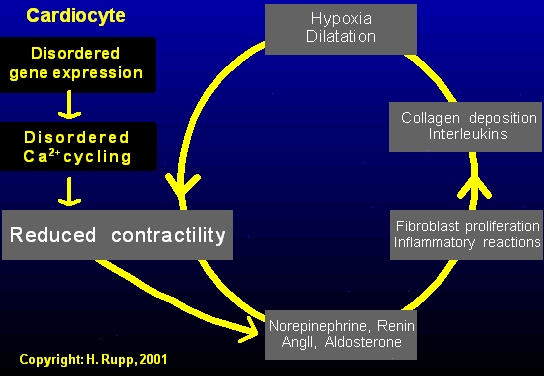
of Heart Failure - it starts at the cardiomyocyte!
A pathological overload of the heart
results in specific defects in gene expression of the hypertrophied
cardiomyocyte. The resulting protein phenotype is not adapted to the
e.g. increased diffusion distances of the the enlarged cardiomyocyte.
The mechanical performance of the cardiomyocyte is reduced.
Because the pump function of the heart
is derived from the contraction of individual cardiomyocytes, the
overall function of heart muscle is reduced. This depressed function is
counteracted by the body using mechanisms that are appropriate for
acute adjustment of heart performance, e.g. due to postural changes or
blood loss.
A vicious cycle is initiated involving
neuro-endocrine activation involving the sympathetic nervous system and
the renin-angiotensin II-aldosterone system (RAAS). Although the
neuro-endocrine activation results in an apparently improved pump
function of the heart, a remodeling of the extracellular matrix occurs
further aggrevating the impaired pump function of the heart.
As a consequence of the enhanced
catecholamine, angiotensin II and aldosterone influences, collagen
synthesis is stimulated resulting in an enhanced collagen deposition,
i.e. fibrosis of the heart. The increased collagen content of the heart
has various detrimental actions on the mechanical performance, e.g.
increased stiffness, and provides therefore a further stimulus for
neuroendocrine activation.
Prevention
of Progression of Heart Failure - the cardiomyocyte as novel drug target
A pathological overload of the heart
should be avoided. Taking into account that less than 40% of
hypertensives are adequately treated, the goal of preventing a
pathological overload of the heart will unfortunately remain an
unrealistic aim. Major efforts are needed to avoid the occurrence of hypertension and the very often
associated diabetes type-2.
Any depression of cardiomyocyte
function should be prevented. Currently available drugs appear not to
be designed for this target. We have identified agents which
selectively improve the function of overloaded hearts by interfering
with the gene expression of cardiomyocytes, i.e. 'transcriptional
modulators'. We hypothesize that early interference with defects in
gene expression of cardiomyocytes prevents the deletrious
neuro-endocrine activation.
If neuro-endocrine activation has
already occurred because the progression has not been diagnosed, drugs
are needed targeted at the sympathetic overactivity and activation of
the renin-angiotensin II-aldosterone system. These drugs prolong life
expectancy but cannot prevent congestive heart failure. A combination
with selective 'transcriptional modulators' targeted at gene expression
of cardiomyocytes is hypothesized to contribute to prevention of heart
failure.
Metabolic
Modulation of Cardiomyocyte Gene Expression
This approach is targeted at an
unfavorable gene expression of a pathologically (e.g. hypertension)
overloaded heart. A perturbed gene expression of ion pumps or channels
of the heart muscle cell appears as a very early event in a cascade
finally leading to impaired pump performance of the heart.
Pharmacological strategies are developed that can increase the activity
of the calcium pump of sarcoplasmic reticulum (intracellular calcium
store) and thereby increase rate of ventricular contraction and
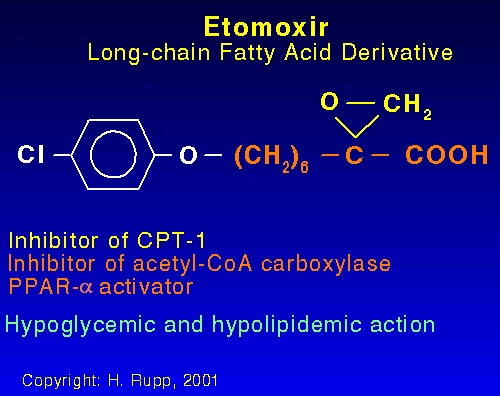
relaxation. Our current lead compound is etomoxir which
inhibits mitochondrial carnitine palmitoyltransferase-1 and activates
PPARalpha. Since various other genes are affected in a coordinated
manner, the re-programming of gene expression results in an altered
protein phenotype. The unfavorable protein phenotype of an overloaded
heart is thought to induce neuroendocrine activation involving
catecholamines, angiotensin II and aldosterone resulting in a vicious
cycle. The outcome is seen in fibrosis of the heart involving
remodeling of the extracellular matrix.
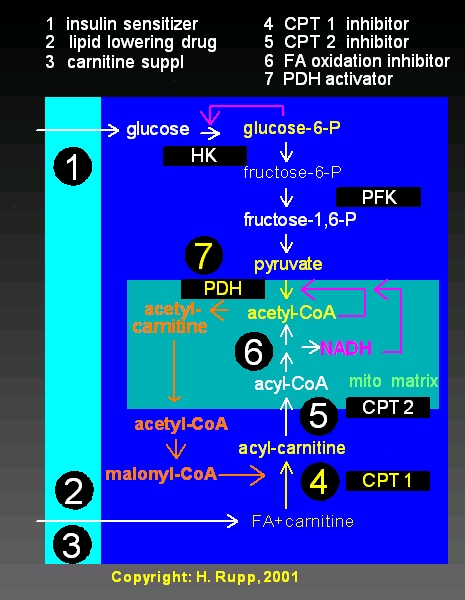
Metabolic modulation of gene expression
would ideally result in a heart muscle with normal molecular
structures. A cartoon of this approach served as logo
of the Oscar Langendorff Satellite Meeting of the International Society
for Heart Research (ISHR) "Control of Cardiovascular Gene
Expression. From Molecular Nutrition to Metabolic Syndromes and Shock"
held in Stuttgart (June 29-July 1, 1995).
A detailed overview on drugs
which could be useful for modulating cardiac metabolism and thus gene
expression of cardiomyocytes can be downloaded as PDF file: The Use of Partial Fatty Acid Oxidation
Inhibitors for Metabolic Therapy of Angina Pectoris and Heart Failure
A key feature of these drugs is an enhanced oxidation of glucose.
Although glucose
is utilized in all organs of the body, links with gene expression
of the cardiomyocyte remain ill-defined.
Regression
and Prevention of Cardiac Fibrosis
This approach is targeted at regression or
prevention of fibrosis of the heart. Fibrosis is a deleterious event
that reduces the mechanical performance of heart muscle and impairs
oxygen supply to the heart muscle cell. There is increasing evidence
that angiotensin II and aldosterone have crucial influences on the
remodeling of the extracellular matrix. Drug interventions are needed
that can specifically reduce fibrosis and have a beneficial influence
on the remodeling of the extracellular matrix (cardioreparation).
However, neuroendocrine activation associated with extracellular
remodeling appears to be preceded by an impaired performance of the
heart muscle cell itself. Various vicious cycles arise from an
unfavorable protein phenotype of the heart muscle cell. Since other
genes are affected in a coordinated manner, the potential of
reprogramming gene expression of the heart muscle cell in a specific
manner by novel drug approaches is studied actively.
The Experimental Cardiology Laboratory
is part of the Heart
Center of the Philipps
University of Marburg, Germany. The Department of Internal Medicine
and Cardiology (Prof. Dr. Bernhard Maisch, Chairman) is a leading
center for the advanced diagnosis and treatment of heart diseases of
ill-defined causes (cardiomyopathies). Please contact us also for
receiving further information on our Postdoctoral Program
For information on drug-induced
modulation of gene expression of the cardiomyocyte, please contact Heinz Rupp, Ph.D.,
Professor of Physiology, personal data,
Google
Scholar Citations
Publications on
cardiovascular effects of etomoxir
Patents for use of
etomoxir in treatment of heart failure
For information on drug-induced
modulation of extracellular matrix remodeling, please contact Christian G. Brilla,
M.D., Ph.D., Professor of Medicine, personal data.
last modified December 14, 2012 by
HR
(rupp(at)staff.uni-marburg.de)